
Short Answer First
If your garage door starts closing and then reverses back up, or refuses to close at all, the cause is almost always one of a short list of things: misaligned or dirty safety sensors, incorrect opener force or limit settings, a track obstruction, worn rollers or cables binding the door, or a spring that's lost tension and thrown the door off balance. Work through them in that order, because that's the order a technician would, and it's the order from most common and cheapest to fix, to least.
What You're Seeing
Before the causes, it helps to know which symptom you have, because they point in slightly different directions:
- Door closes partway, then reverses up on its own — almost always a sensor or force-setting issue.
- Door won't close at all; opener hums or clicks but nothing moves — often a limit setting, obstruction, or a seized roller.
- Door closes fine by remote but not by wall button, or vice versa — points to wiring or the control board, not the door itself.
- Door slams down fast instead of closing smoothly — usually a spring that's lost tension, which is a safety issue, not just an annoyance.
1. Safety Sensors (Check This First)
Every modern opener has two small sensors a few inches off the floor on each side of the track, aimed at each other. If their beam is broken, blocked, or even slightly misaligned, the opener will refuse to close the door or reverse it mid-travel as a safety precaution. This is by far the most common cause of a reversing door.
What to check: look for a solid light on both sensors (one is usually steady, one blinks when the beam is clear). Afternoon downpours and humidity common in this area can fog or film over the lenses, and a sprinkler, a parked bike, or even a spiderweb can break the beam. Wipe both lenses with a soft cloth, make sure nothing is in the beam's path, and gently nudge the brackets until both lights go solid. This fix costs nothing and solves the problem more often than any other step on this list.
2. Opener Force and Limit Settings
If the sensors are clean and aligned and the door still reverses, the opener's travel limit or down-force setting is likely off. These settings tell the motor how far to travel and how much resistance to push through before it assumes something is in the way and reverses. Humidity swings can cause wood-composite doors to swell slightly during wet months, adding just enough resistance to trigger a false reversal. Most openers have small adjustment dials or a menu for this; turning the down-force up slightly (in small increments) often resolves it. If you're not familiar with your opener model, this is a quick job for a technician rather than guesswork, since too much force defeats the safety reversal feature entirely.
3. Track Obstructions or Misalignment
Next, walk the full length of both tracks. Look for dirt buildup, a dented section, or a track that's pulled slightly away from the wall — something that happens more often here after a storm with sustained winds, even without visible damage to the door itself. A door that's catching on a bent track will often stop or reverse at the exact same spot every time, which is a useful clue. Minor dents can sometimes be tapped back into shape; anything more than minor should be replaced rather than forced.
4. Rollers and Cables
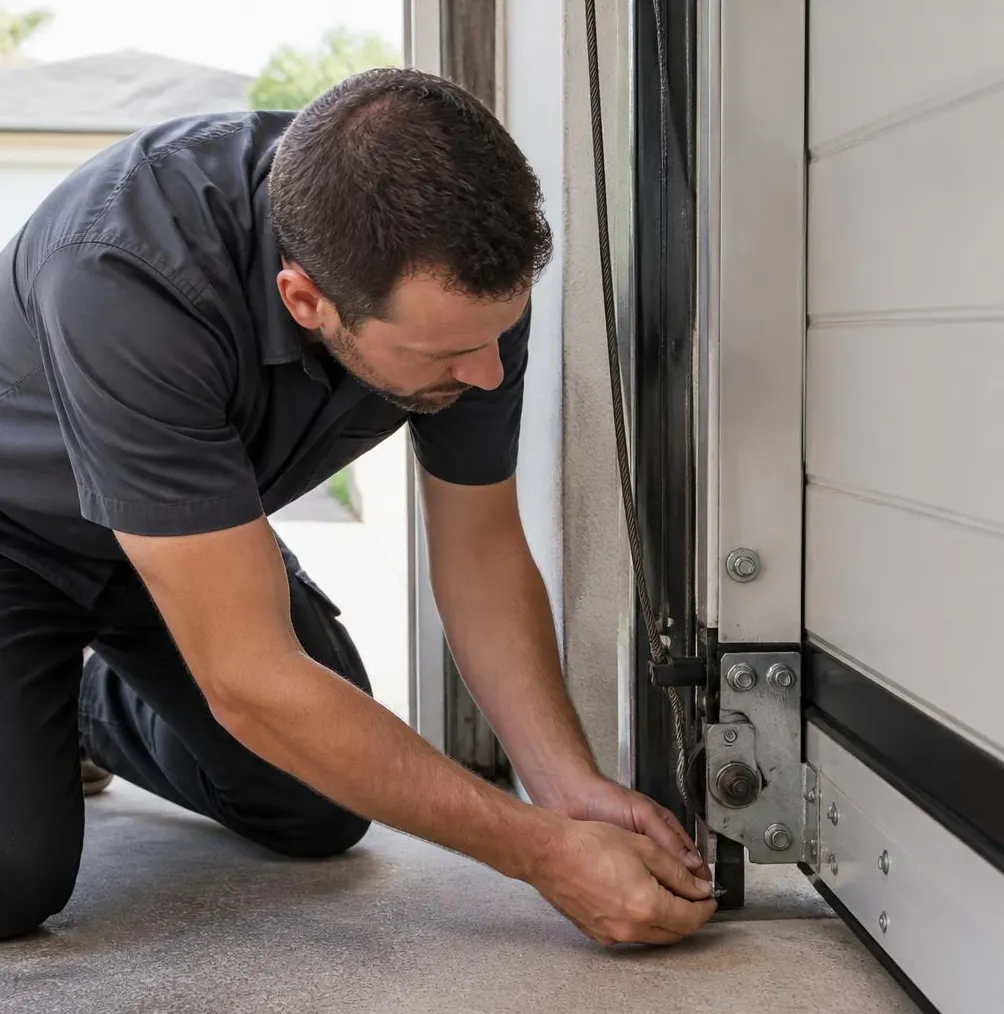
Worn, rusted, or cracked rollers create drag that an opener reads as resistance, triggering a reversal. In this climate, rollers and roller stems are prone to rust from humidity and, for homes closer to the coast, salt air — it's worth checking them even if the door looks fine at rest. A frayed cable can also catch on the drum and cause the door to hang or reverse unevenly on one side. Cable and roller replacement is routine work, but it should be done before the cable fails completely, since a snapped cable under tension can let the door drop.
5. Springs and Balance
Last on the list, but the one to take seriously: disconnect the opener and lift the door by hand. It should move smoothly and stay put when lifted about halfway. If it feels heavy, drops on its own, or the opener strains and reverses specifically on closing, the springs have likely lost tension. A door that's out of balance isn't just annoying — it's unsafe to operate manually and puts extra strain on the opener motor and gears. This is not a DIY repair; torsion springs are under heavy tension and require the right tools and experience to replace safely.
When to Call Lake Mary Door & Opener
If you've checked the sensors and the problem persists, or if lifting the door by hand feels heavy or uneven, it's time to call. We'll diagnose whether it's an opener adjustment, a Cable & Roller Replacement, or a Garage Door Spring Repair, and we carry parts rated for Florida's wind-load and humidity conditions so the fix holds up through storm season.
If your garage door in Lake Mary, Sanford, Longwood, or anywhere nearby is reversing or won't close, call Lake Mary Door & Opener today for same-day service.